


New lessons and homework tasks on Primary MyiMaths

Posted in Primary
We are pleased to announce the release of eleven new pairs of matching lesson and homework tasks on Primary MyiMaths!
These new resources take a more granular approach to deepen children’s understanding of area and perimeter.
The new lesson and homework pairs cover the following topics:
- Perimeter on a grid
- Measuring perimeter
- Perimeter of a rectangle
- Calculating perimeter
- Area of a rectangle
- Using the area of a rectangle
- Area of a right-angled triangle
- Area of any triangle
- Using the area of a triangle
- Area of a parallelogram
- Using the area of a parallelogram
The lessons encourage children to reason mathematically and reflect on the methods they are using.
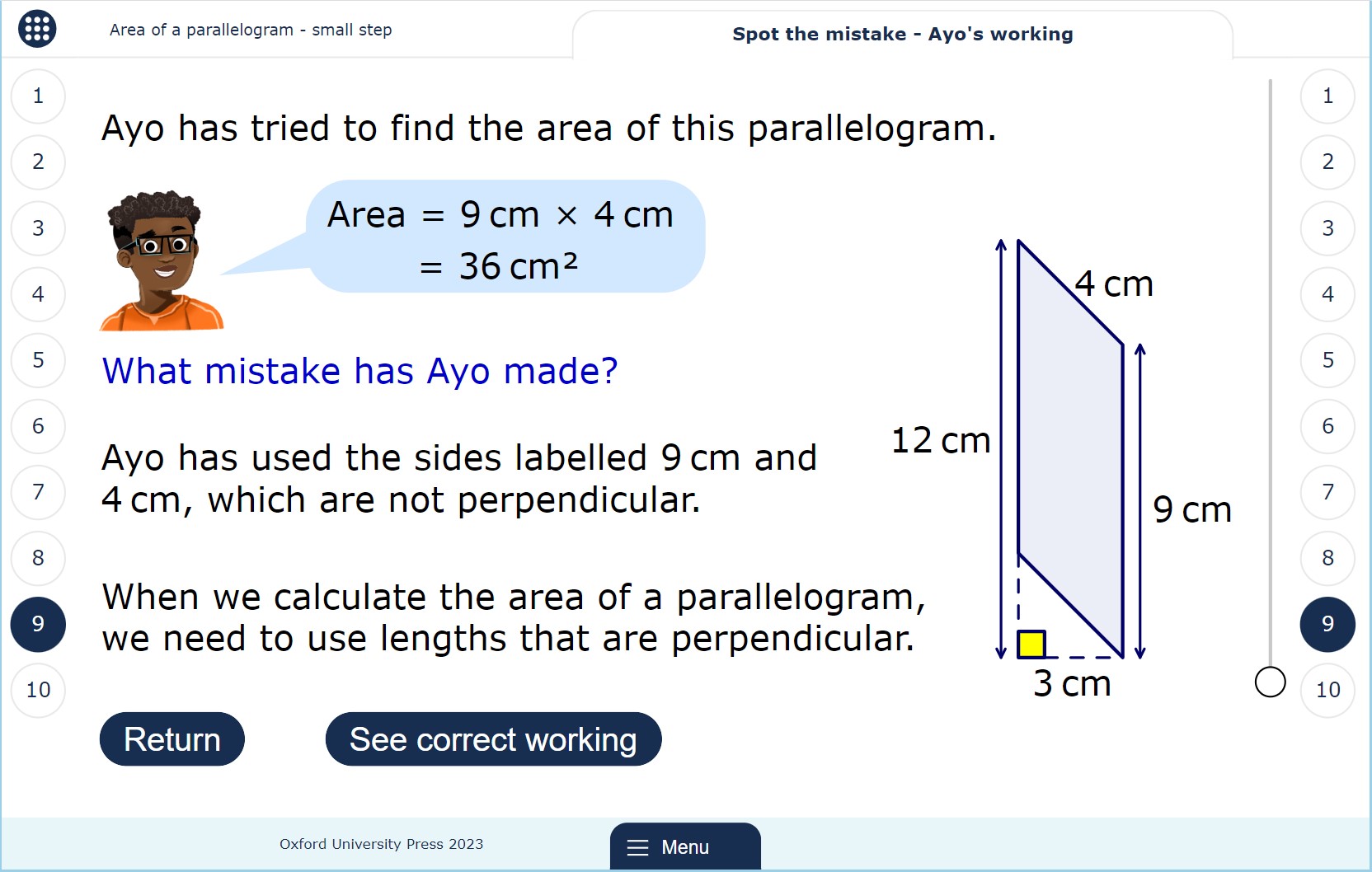
This lesson page reminds children that when we calculate the area of a parallelogram, the base and height need to be perpendicular.
The questions in the homework task are pitched such that any child who is secure with the concepts can achieve success on both question pages.
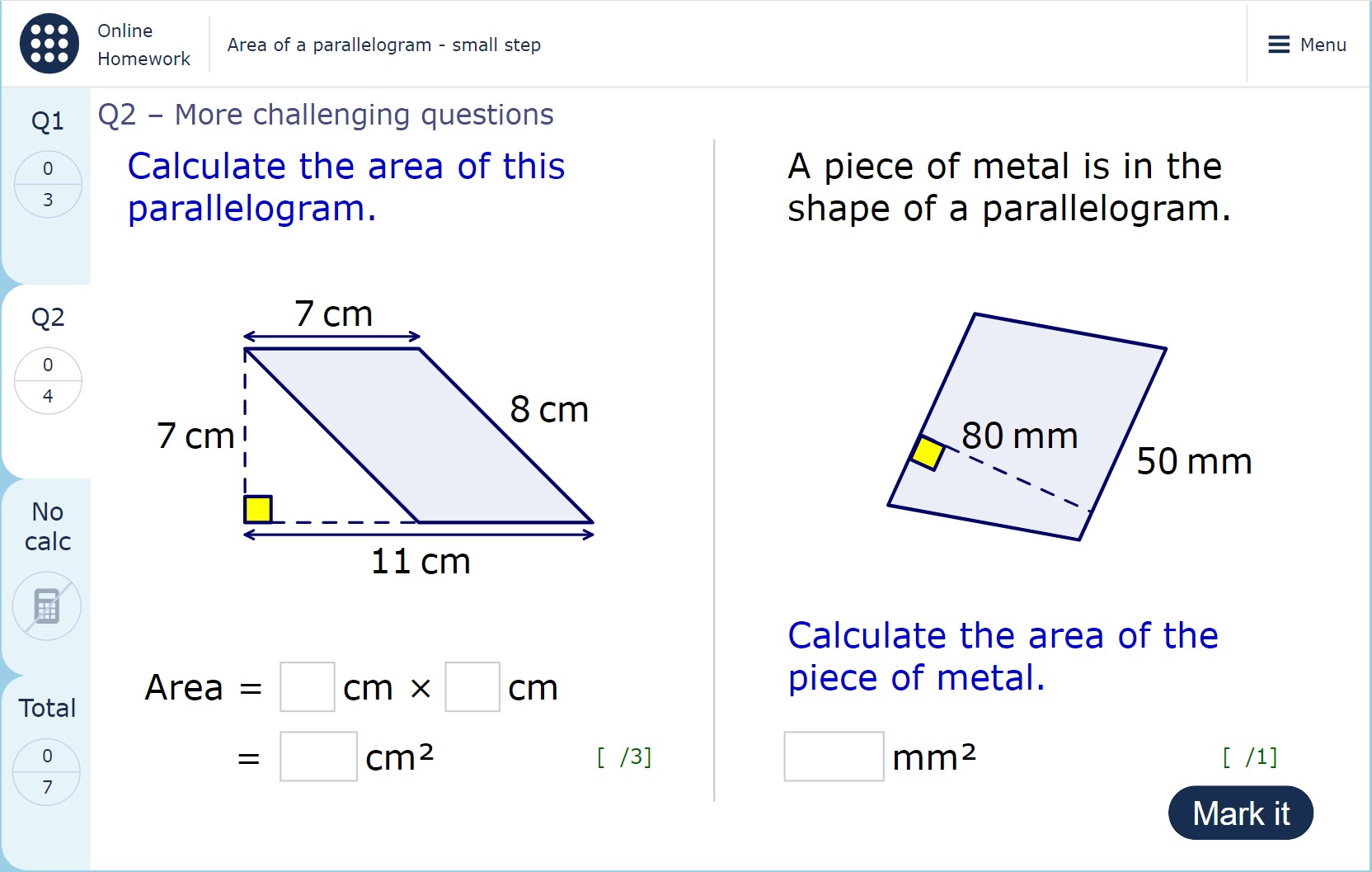
On the first page of this homework task, children find the area of simple parallelograms. On the second page they need to decide which lengths to use in their calculation and solve a simple problem in context.
We hope you enjoy these new resources!